
I have been to every major art museum in the United States. By “major,” I mean the top thirteen most-visited institutions in the country. (I have not been to #14, the Cleveland Museum, and have thus drawn my arbitrary line there.)
My hot take: of the thirty-odd art museums I’ve been to, the Philadelphia Museum of Art—or PhArt, as locals called it during its brief rebranding—is the best. It does not have the most extensive collection, nor does it boast the most major works. But its permanent collection is well-curated, and its special exhibits are thoughtfully chosen. Also, it holds particular personal significance to me, and we’ve already established the importance of my subjective experience in these rankings.
On my first visit to Philadelphia in high school, I dodged hordes of Rocky imitators while walking up the museum’s monumental steps. As an angsty teenager, I loved the 1976 film Taxi Driver and therefore hated Rocky for the mortal sin of winning the Academy Award for Best Picture that year. After my visit, I wrote a screed on my Xanga about these Rocky-adoring philistines.
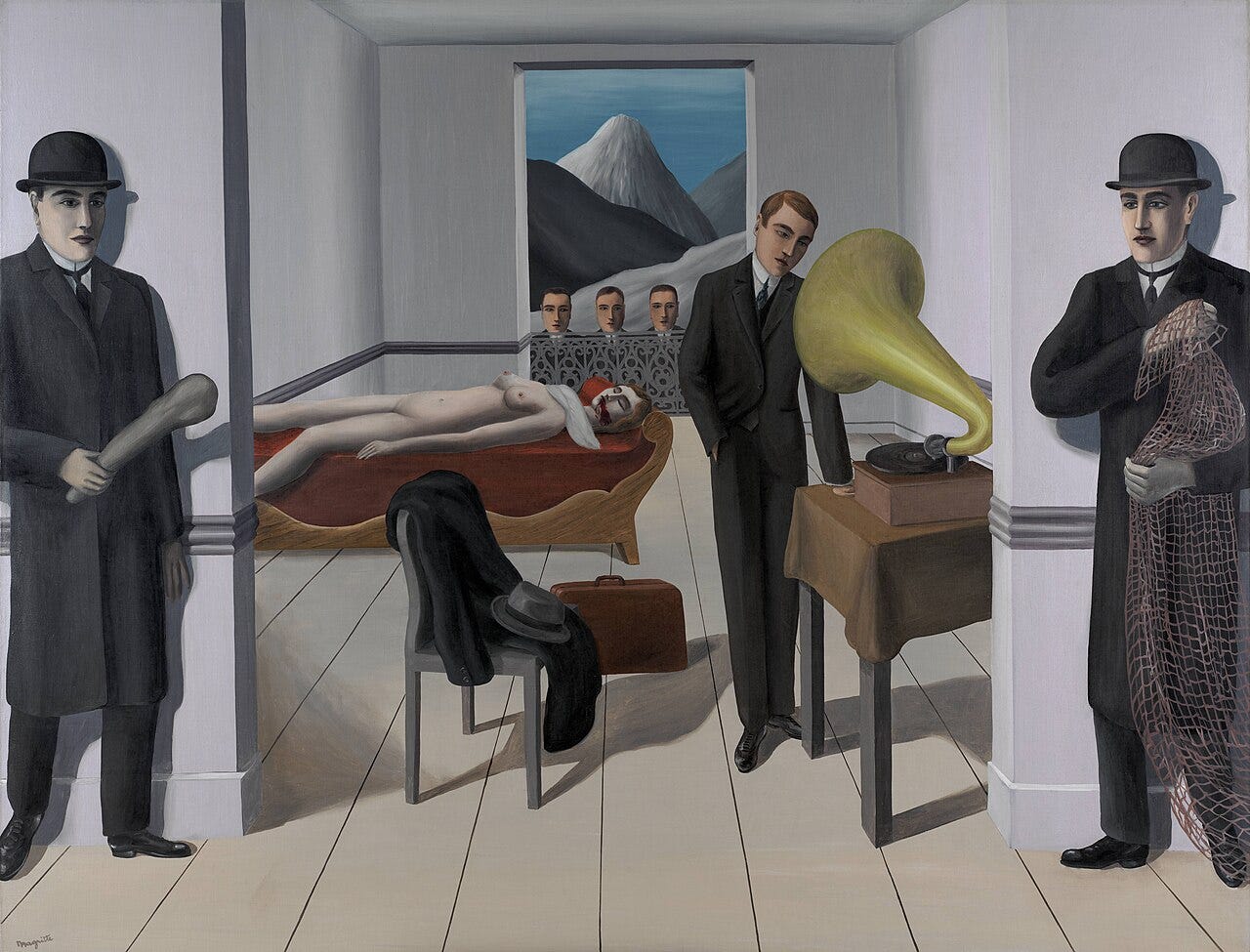
When I like a painting, I will scrutinize it for what likely strikes passersby as an uncomfortable amount of time. The first time I did this was at MoMA, standing in front of Magritte’s The Menaced Assassin. In the painting, a murderer calmly listens to a gramophone, unaware of the detectives lying in wait, while his victim—a nude, bloodied woman—lies supine on a chaise behind him. The painting, evocative and enigmatic, sparked my lifelong interest in Surrealism.
The second time this happened was in Philadelphia. After dodging the Rocky impersonators, I wandered through the museum’s collection chronologically, starting with its impressive medieval art collection, before finding the Surrealist wing. Among the Dalis and Mirós, I spotted a relatively modest canvas, a semi-nude portrait of a woman standing in a hallway. But as I walked closer, I was hypnotized. Her skirt, which at a distance looked like plant fibers, was actually composed of writhing human bodies. At her feet was a bizarre winged creature, and behind her was an infinite corridor of doors. She stared straight at me directly, inscrutably, without the come-hither softness I had grown accustomed to seeing in galleries.
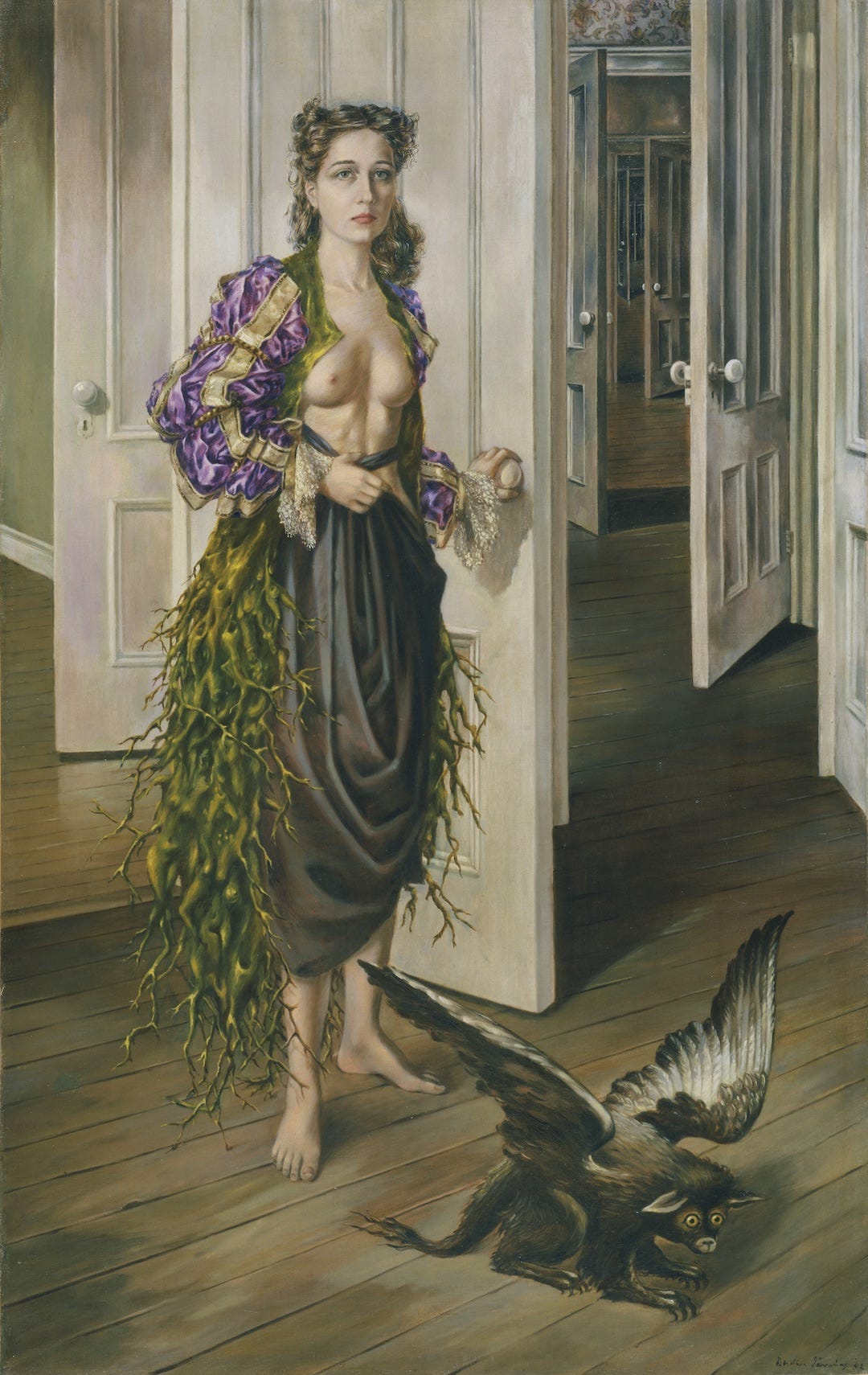
I looked at the art plate—Birthday (1942) by Dorothea Tanning—and realized I had seen countless female nudes but none that were self-portraits. Great art was created by great men, the Scorseses and Magrittes of the world. Surrealism’s founding document, André Breton’s First Manifesto of Surrealism, centers entirely on the experience of men; if women are mentioned at all, it is as romantic conquests and Freudian objects of desire.
But in her review of a new translation of Breton’s Surrealist literary work Nadja, Susan Rubin Suleiman writes that “it’s too easy to wax ironic about Breton’s blind spots and self-deceptions, as well as about the ‘all-male club’ that was the Surrealist group in its early days.” Although Surrealism was dominated by male artists in its nascence, as the movement evolved, women played a pivotal role in its development. As art historian Whitney Chadwick writes in her introduction to Women Artists and the Surrealist Movement:
No artistic movement since Romanticism has elevated the image of woman to as significant a role in the creative life of man as Surrealism did; no group or movement has ever defined such a revolutionary role for her. And no other movement has had such a large number of active women participants [...] Yet the actual role, or roles, played by women artists in the Surrealist movement has been more difficult to evaluate, for their own histories have often remained buried.
The body of criticism about the roles women played in Surrealism is extensive and varied. Méret Oppenheim—the only Surrealist artist I studied in college, and the first whose work I encountered in person (her Object at MoMA, an iconic sculpture of a fur-covered teacup) —requested that her work not be reproduced in Chadwick’s book, saying, “Personally I consider the problem of female versus male as solved, although I know many have not arrived at this point.” My intention isn’t to address this “problem,” but I wanted to highlight a few Surrealist artists who played pivotal roles in art history, and who often occupied dual roles as artist and muse.
Dorothea Tanning (1910–2012)
I wish you wouldn’t harp on that word, “women.” Women artists. There is no such thing—or person. It’s just as much a contradiction in terms as “man artist” or “elephant artist.”
– Dorothea Tanning
Many years after I first saw Birthday, I found myself at a swanky work event in Keira Knightley’s old flat in Shoreditch. There, through my abundant charm and charisma, I managed to score a ticket to the Tate Modern’s Dorothea Tanning. (That is, I happened to strike up a conversation with someone whose company gave employees free Tate tickets, and she wasn’t able to attend.) I liked Tanning before I went, and I loved her after.
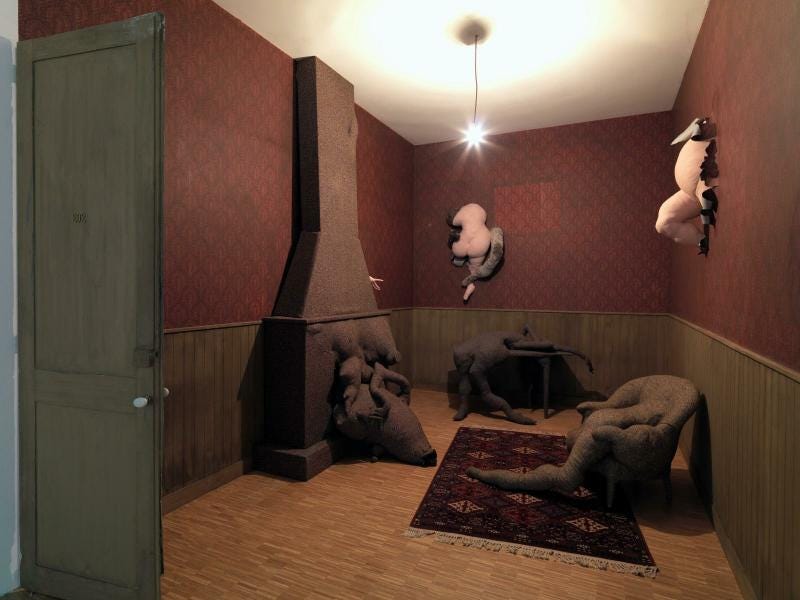
Like all of the artists I’m highlighting, Dorothea Tanning was long-lived. Born in 1910 in Illinois, Tanning would go on to celebrate 101 birthdays in her life. And across these long lives, there’s another common thread: they refused to be pinned down. Tanning was a multihyphenate: painter, sculptor, costume designer, poet. Many of her paintings—like Eine Kleine Nachtmusik (1943), Maternity, and The Guest Room (1950–2)—transform domestic interiors and scenes into uncanny Gothic dreamscapes. She designed the sets and costumes for La Sonnambula (1946) and other Balanchine ballets. In the 1950s, she moved away from Surrealism, developing an abstract, prismatic style. And in the 1970s, she began creating amorphous sculptures from fabric. Like her paintings, these fleshy soft sculptures explored the human (often female) body and themes of transformation, continuing her refusal to stay confined to a single medium or aesthetic.
Leonora Carrington (1917–2011)
Born to a pious and well-to-do Catholic family in England, Leonora Carrington developed a taste for rebellion early on. When she met the local priest, a fourteen-year-old Carrington lifted up her dress, revealing that she was in commando. “Well,” she asked the priest, “what do you think?” Her rebellious spirit—which resulted in her expulsion from multiple schools in Essex—led her to London (where she briefly studied art; she was mostly self-taught) and Paris. Escaping the Nazi occupation of France, she found herself in Madrid, then an asylum on the coast of Spain, and after a brief stint in New York, Mexico City, where the then-25-year-old artist would spend the rest of her life. This is only scratching the surface of her cinematic biography.
Both a painter and prolific writer, she penned the asylum memoir Down Below, in which she describes being reincarnated as “an androgyne, the Moon, the Holy Ghost, a gypsy, an acrobat, Leonora Carrington, and a woman.” It’s no wonder, then, that her paintings teem with hybrid creatures and androgynous figures, reflections of her untamed spirit. Her first major painting, a self-portrait from the late 1930s, depicts a wild-haired Carrington next to a lactating hyena, and things just get weirder from there.
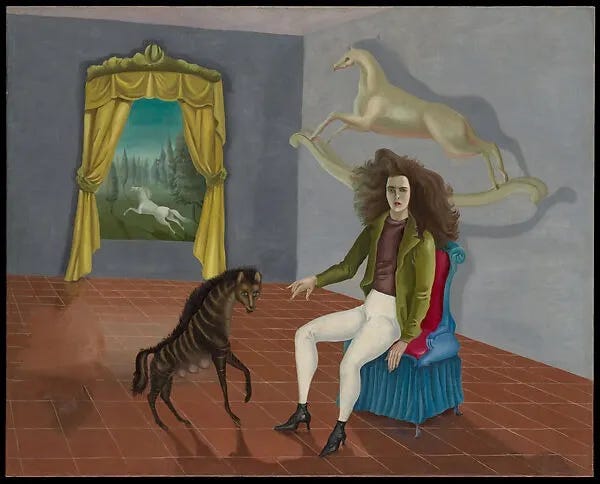
In Mexico, Carrington developed an interest in the country’s indigenous traditions and spiritual rituals, which informed her artistic vocabulary. Many of her paintings are set in surreal kitchens, combining her interests in cooking and alchemy. Her real-life kitchens were only slightly more normal: as a dinner party host, Carrington would follow archaic recipes from ancient cookbooks, serving guests bizarre, sometimes-inedible dishes, such as omelettes made from their own hair.
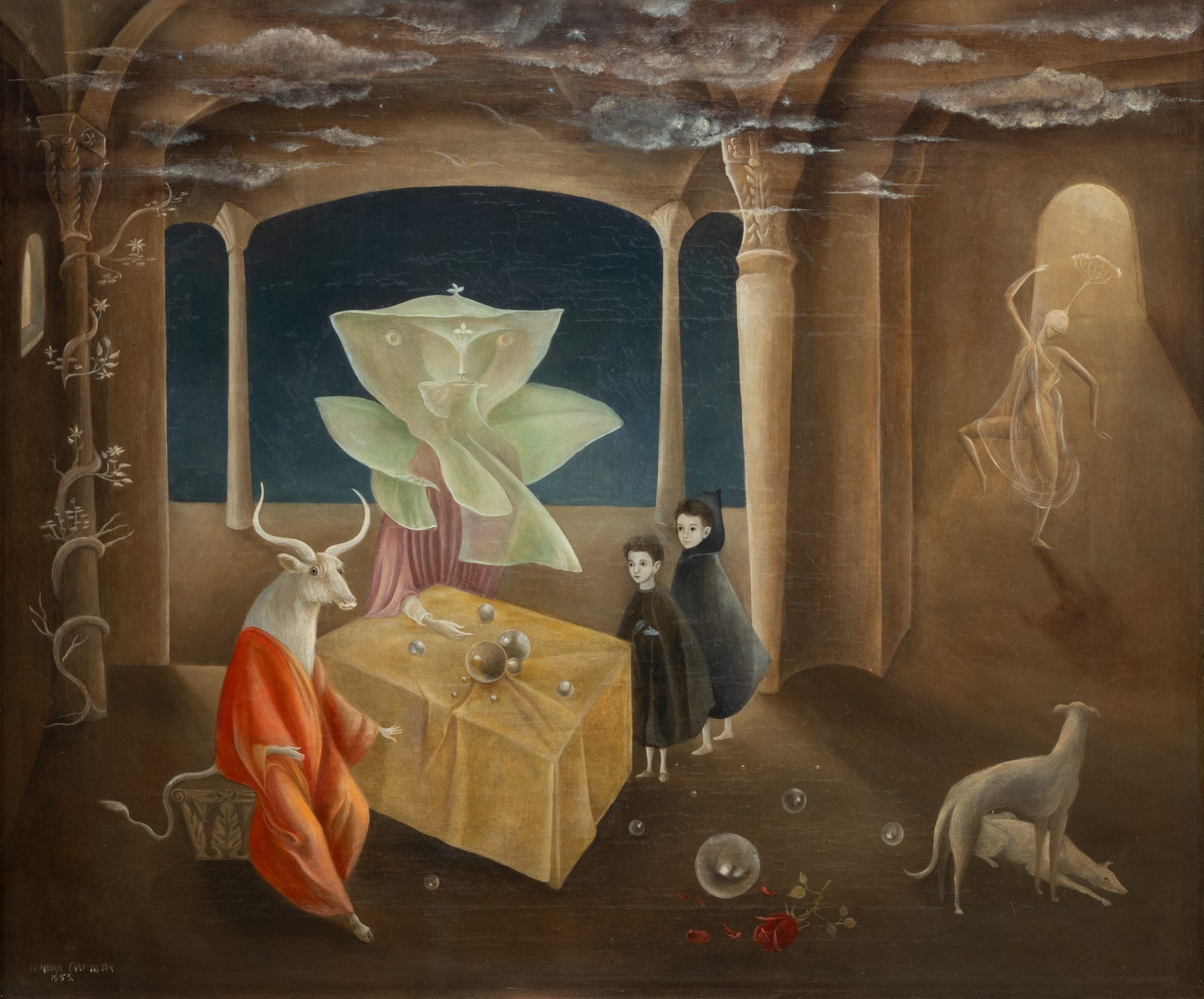
Like her life, Carrington’s art and writing refuse to obey boundaries or genres, blurring the distinction between life and art.
Dora Maar (1907–1997)
Born in Paris as Henriette Theodora Markovitch, Dora Maar is a bit of an odd case. She was extensively trained in the fine arts and photography, a medium some Surrealists dabbled in but few dedicated themselves to. She ran in Surrealist circles in the 1930s, exhibiting her photographs in international Surrealist shows across New York and Europe, but her association with the movement was relatively brief.
Unlike Carrington and Tanning, I was familiar with her as a muse and artistic subject before I encountered her work. And her work is, in a word, strange. Before you come at me and say, “But Kristen! Surrealists are strange, that’s kind of their thing,” yes, I’m aware. I don’t just mean she created enigmatic or dreamlike images, though she did often do that. I also mean that she moved between media and straddled styles in ways that defy easy categorization.
Maar got her start as a commercial photographer at a studio she founded with Pierre Kéfer in 1931, finding success in advertising and fashion photography. “Got her start” is perhaps inaccurate here, because even as she developed an interest in Surrealist imagery and techniques—found objects, photomontage, double exposure—she continued to work commercially. She also simultaneously did realist street photography, documenting the struggles of Depression Era-France.
Her work ranged from stylish to grotesque, with her most famous image, Portrait d’Ubu (1936), falling firmly in the latter category. Inspired by Alfred Jarry’s vulgar play Ubu Roi (1896), the photograph depicts a monstrous, fleshy creature (likely an armadillo fetus, though Maar herself refused to identity the object). Other works from this time, like Shell-Hand, used photomontage to create dreamlike imagery.
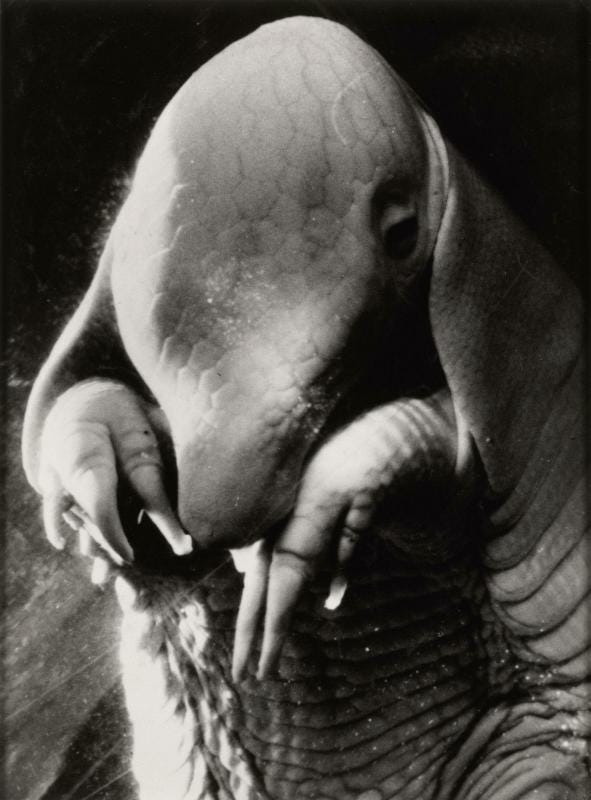
In later decades, she abandoned photography for painting and, as Chadwick says, “renounced Surrealism and adopted a semimonastic life.” Nevertheless, her involvement with Surrealism resulted in some of the movement’s most iconic photographs. The past decade has seen renewed interest in her work, with a major 2019–20 retrospective of her work organized by the Centre Pompidou, Tate Modern, and Getty Museum.
When I first saw Dorothea Tanning’s Birthday at the Philadelphia Museum of Art, I had never heard her name before. I wouldn’t learn about Carrington or Maar until many years later (and in the case of Maar, embarrassingly recently). All I knew was that the woman in that painting stared back at me without apology, and I knew that was the kind of woman I would one day like to become.
Sources and Recommended Reading
Whitney Chadwick, Women Artists and the Surrealist Movement (Thames and Hudson, 1985)
Susan Rubin Suleiman, “On The Precipice” (The New York Review of Books, July 23, 2026 Issue)
Lauren Elkin, “Dorothea Tanning the Shape-shifter” (Tate Etc, Issue 45: Spring 2019)
Merve Emre, “How Leonora Carrington Feminized Surrealism” (The New Yorker, December 21, 2020)
Joanna Moorhead, The Surreal Life of Leonora Carrington
Elizabeth Djinis, “The Strange Surrealist Magic of Dora Maar” (The Smithsonian Magazine, December 5, 2022
“Love, Friendship and Rivalry: The Women Beside the Men in Early Surrealism” (Tate Gallery)