
Welcome to the first quiz from the Trivia Underground! You can submit your responses and see the answers at this link.
Lee Krasner was a prominent action painter, while Helen Frankenthaler was one of the originators of color field painting. Action painting and color field are subsets of what major postwar American art movement? Other artists associated with this movement include Elaine de Kooning, Grace Hartigan, and Joan Mitchell.
French actress Isabelle Adjani received her second Academy Award nomination for playing the title sculptor in what 1988 film?
Ana Mendieta used what substance in her performance piece Rape Scene (1973), the film Moffitt Building Piece (1973), and various works in her Silueta series (1973–1985)? This substance also appears in a visual “diary” by Carolee Schneemann and in Judy Chicago’s 1971 photograph Red Flag.
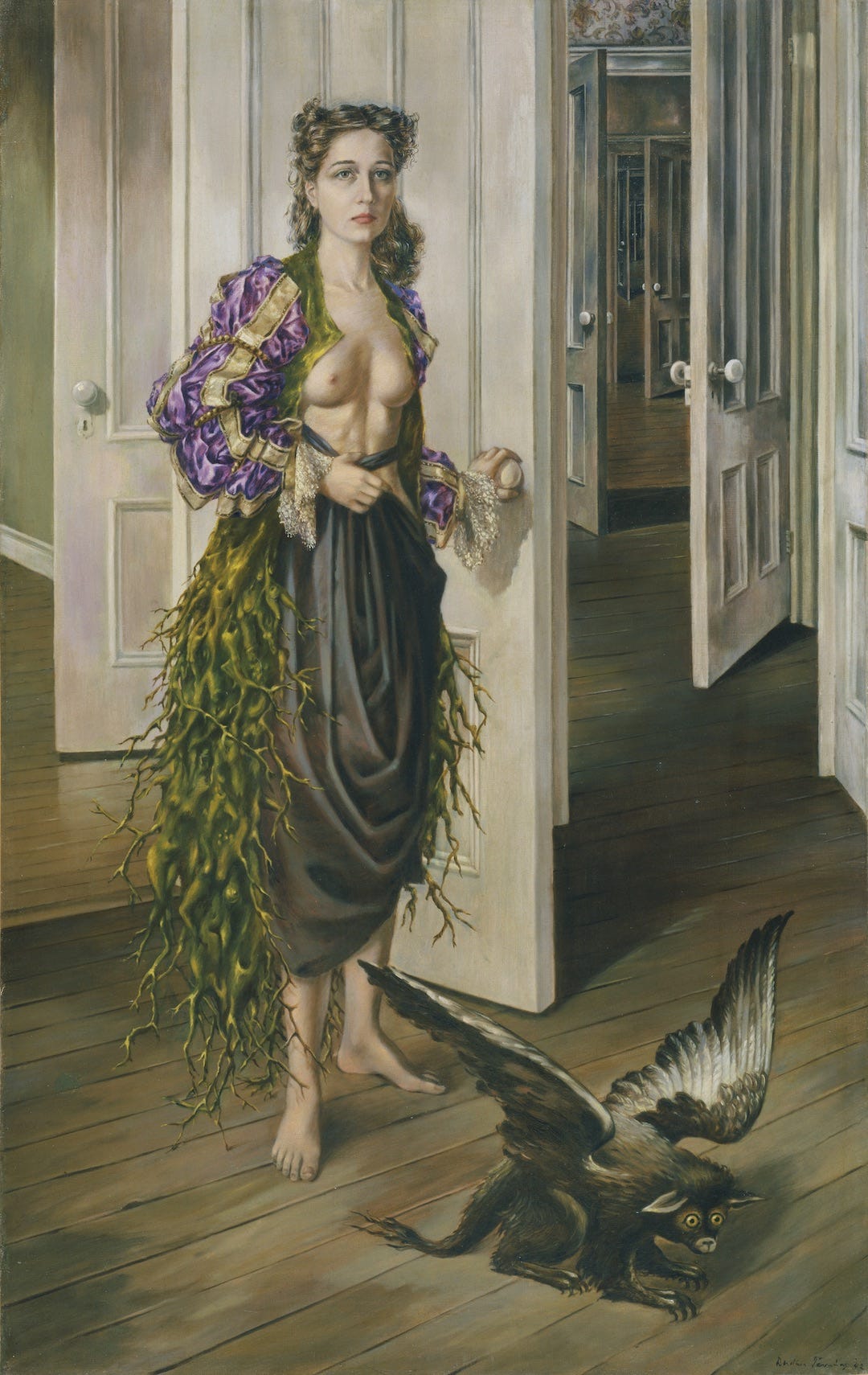
Dorothea Tanning’s 1942 surrealist self-portrait shares its title with what kind of occasion? Tanning, who died in 2012, could have painted 101 versions of this occasion.
What museum hosted a 1964 retrospective for Sonia Delaunay, co-founder of the Orphism movement? It was the institution’s first retrospective devoted to a living female artist in its (then) 171-year history.
Eight of Frida Kahlo’s 55 self-portraits feature what animal? The first, painted in 1937, depicts her pet Fulang-Chang.
Gabriele Münter: Contours of a World is a current exhibition at the Solomon Guggenheim Museum. Münter (1877–1962) was an expressionist painter and a founding member of what Munich-based avant-garde movement?
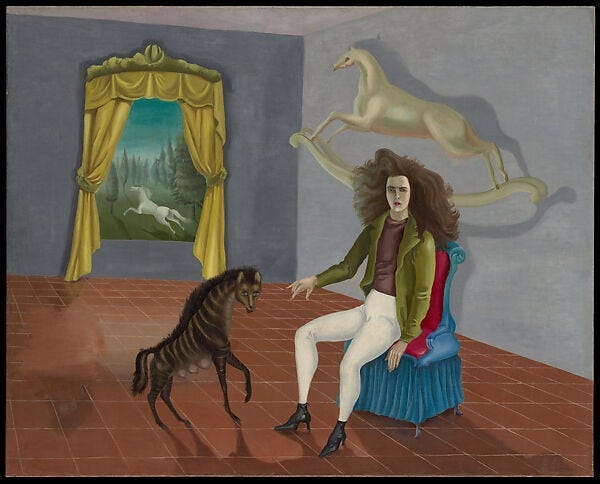
What surrealist painter is depicted in the self-portrait below? Born in England in 1917, she spent most of her career in Mexico City.
Alice Prin (1901–1953), a model and performer turned painter, was known by a name derived from what area of Paris? Located on the Left Bank of the Seine, this neighborhood was a center for the city’s artistic community, serving as the hub for groups like the School of Paris and Les Six.
Marion Mahony Griffin was instrumental in designing what planned city in the early 20th century? The name of this national capital was chosen through a public competition, with entries including Hopetoun, Union City, Myola, and Wattleton.
Kristen, I got crushed on this, for the two predictable reasons. I will be a little defensive and say that it was more Reason A (a matter of the art/media world suppressing the reputations of the “artists in their own right“) than Reason B (my own male bias — I knew a few of the men, and Abstract Expressionism, few/none of the women). But it was both.
You’ve cast a spotlight on bias in the trivia world, but is it more pronounced in trivia than in broader social discourse? It may be… but I’m wondering if there is also room for trivia to redraw the lines and break out of conventional bias… because it can. It’s not academic, explicitly doctrine-driven, or institutional at all, except for the big quiz show media properties. (I would actually say University Challenge is an excellent counter-example, and actually excellent in many ways. I recommend you watch it on YouTube — YouTube.com/@CosmicPumpkin — if you haven’t. I think you might approve of its efforts to bring important women in many domains out the shadows of their men.)
Curious on your thoughts, and I’m also thinking that maybe my homework is to take these questions and see if there’s a way to edit them to give quizzers a back door way getting the points for answers they might not otherwise have, and raise the profile of the artists here in the process.