
“I didn’t have time to be anyone’s muse.” – Leonora Carrington
The Brooklyn Museum is a 560,000 square-foot monument to squandered potential. Plagued by budget problems for much of its existence, it boasts an impressive collection of half a million objects, which its curators seem determined to exhibit in the most chaotic ways imaginable. When I last visited in the summer of 2025, I was excited to see Napoleon Leading the Army over the Alps by my favorite artist, Kehinde Wiley. The museum website describes it as “triumphant” and a “hallmark of our collection.”
So naturally they hid it next to the café bathrooms.
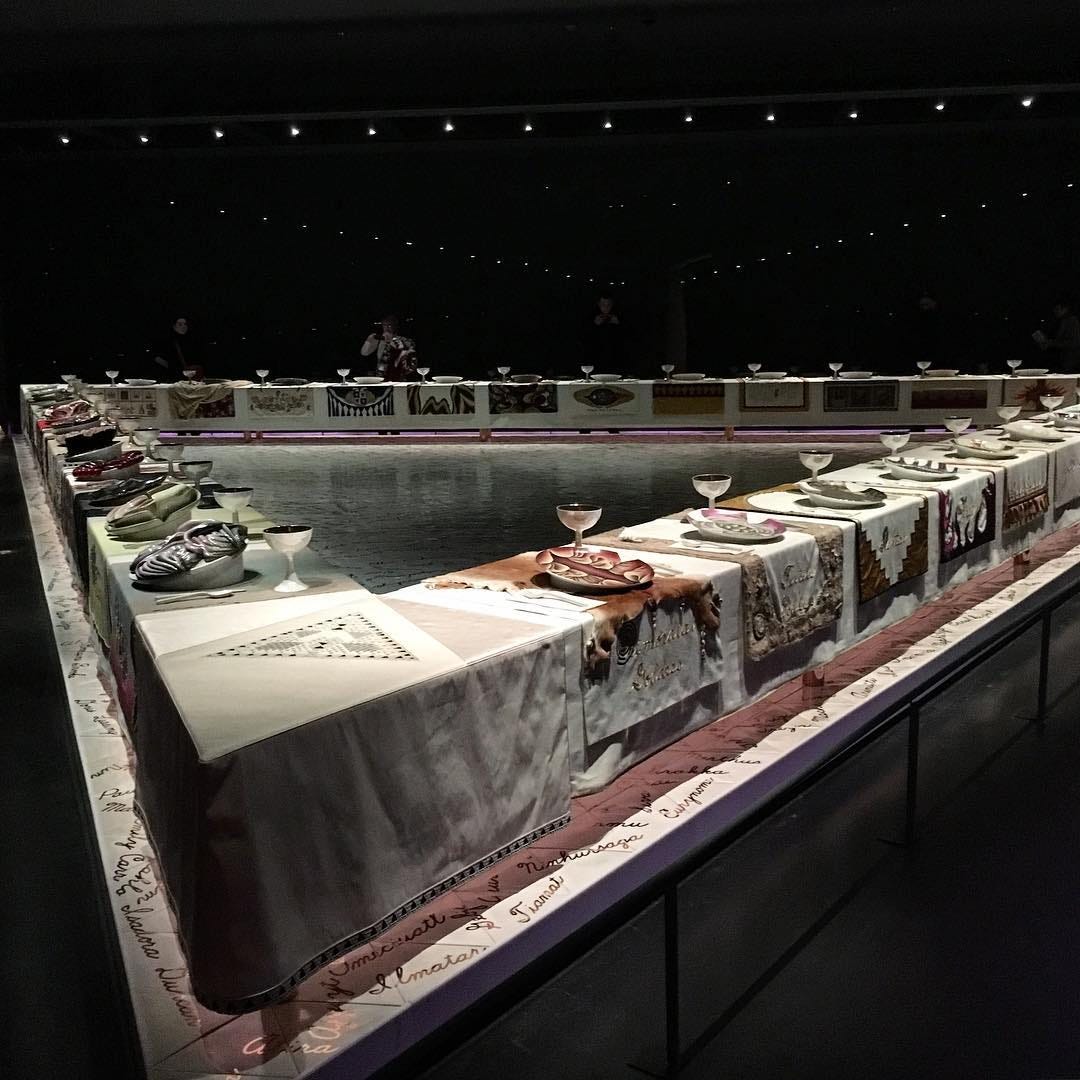
The museum’s crown jewel, Judy Chicago’s iconic 1979 installation The Dinner Party, was similarly impossible to find. I wandered through the labyrinthine fourth floor before spotting a sign for the Elizabeth A. Sackler Center for Feminist Art. The first room I entered had no artwork except, inexplicably, Auguste Rodin’s The Burghers of Calais. This sculpture is currently paired with Nicole Eisenman’s Three Walkers, but lacking this information, I thought I was in the wrong place.

I meandered through two other rooms with dozens of paintings and photographs, grouped together haphazardly and displayed with minimal contextualization. When looking at a photograph by the Cuban-American artist Ana Mendieta, I wondered aloud why it wasn’t in the feminist art collection. (Only later, when it dawned on me that all the works in the room were by women, did I realize that this was the feminist art collection.)
After all, Mendieta powerfully confronted issues like sexual violence and the female body. She first gained fame for her 1973 performance art piece Untitled (Rape Scene) before embarking on her monumental and multidisciplinary Silueta Series. Over more than a decade, she blended earthworks, performance, photography, and self-portraiture to explore gender and identity.
On the placard, her lifespan jumped out at me: 1948–1985. Having just turned 37, I had outlived Mendieta. She died violently, falling 33 stories from her apartment during an argument with her husband. Several days prior, Mendieta had told her family that she was planning to leave him for his infidelities. In his 911 call, he described their argument:
My wife is an artist, and I’m an artist, and we had a quarrel about the fact that I was more, eh, exposed to the public than she was. And she went to the bedroom, and I went after her, and she went out the window.
After being acquitted of her murder for lack of evidence, he would go on to exhibit his work in the world’s leading museums until his death at 88 two years ago. His statement haunts me: The passiveness in which he describes her death (she went out the window). The alleged subject of their argument (I was more exposed to the public than she was). It was not his infidelities but rather his fame that led to their argument, that led to her death. This sentence distills the trope of a woman artist being eclipsed by her successful husband into its most sinister form.
Creatives are naturally drawn to each other, but it is always the woman who is “an artist in her own right.” Frida Kahlo’s Encyclopedia Britannica entry begins with her marriage, declaring in the first paragraph that “her work was often overshadowed by the murals of Rivera.” Meanwhile, the entry for Diego Rivera doesn’t mention Kahlo until the eighth paragraph. By the time his relationship with Kahlo comes up in passing, we have already learned about his socialist ideology, early life, education, creative influences, style, and political activities.
While Rivera may have had more success in his lifetime, Kahlo is objectively the more famous artist now. So why do we continue to frame her life and work around her husband’s?
Some artists and designers—Ray Eames, Jeanne-Claude, Sonia Delaunay—collaborated so closely with their partners that it is impossible to disentangle their work. And in rare instances, the reverse is true. You’d be hard-pressed to find an article about Ulay, for instance, that doesn’t discuss his romantic and professional partnership with Marina Abramović. Georgia O’Keeffe is one of the few true household names in American art, whereas the average non-art enthusiast knows little (if anything) about Alfred Stieglitz.
But these exceptions are few and far between. More often, a woman artist is the supporting character in her husband’s story: a muse and dutiful wife who supports his creative endeavors. This kind of framing reinforces long-standing biases about whose stories are worth telling.
I have been guilty of doing this in trivia questions I’ve written, so I conceived of the first series for the Trivia Underground as a challenge to myself. Over the next few months, you’ll find articles and quizzes that cover women’s artistic contributions without mentioning their romantic relationships (with a few exceptions to establish context).
Writing these articles has reshaped how I think about art history, and I hope it will do the same for you.